Panacea Life Technologies
Every technology invented by Bogdan Dicoias at Panacea Bio Chem, in one place. The formulation science that decides what goes into each cake; the low-temperature preservation and process stack that keeps them intact; and the instruments that synthesise, dry and deliver fragile peptides — each explained plainly, and linked to its own site.
 Panacea IQP — Interactive Query Portal ↗
Formulation, Dosing & Science
4The formulation science and models that decide what goes into each cake and how it is dosed.
- P-EARLs ↗Additive reservoirsEncapsulated additive reservoirs dosed alongside the peptide, themselves treated with OxyDeplete and ArgonLock.
- PolyGluNAD ↗NAD+ redox cakeAn exploratory cake identity that co-locates NAD+, reduced glutathione and polydatin in a trehalose glass — a redox platform, held as a directional research target.
- The Dicoias Equation ↗The formulation-space modelThe formulation-space model behind the recipes — how a peptide is designed and its multi-layer cake composed.
- Low-Temperature DisciplineThe end-to-end cold processThe cold process that ties it together: finishing at −3 to −5 °C, sublimation ending at −8 to −10 °C, desorption at −3 to −5 °C, with no +40 to +60 °C overheat — preserving binding affinity and bioavailability.
Preservation & Process Technologies
12The proprietary low-temperature preservation and process stack that keeps a fragile molecule intact from bench to point of use.
- TgShift™ ↗Glass-transition controlRaises the working glass-transition temperature (Tg′), letting the glassy matrix that immobilises the peptide form without the collapse that would crush it.
- Cryolapse™ ↗Gentle lyophilisationGentle freeze-drying and the pressure-collapse doctrine — drying a fragile protein the way nature dries a tardigrade.
- Cryosurge ↗Freeze-exotherm controlControl of the freezing exotherm and the ice-nucleation surge during the freeze stage — distinct from Tg/Tg′ and collapse phenomena.
- Cryoflare ↗Sublimation-front armingArming and control of the sublimation-front behaviour later in the drying cycle.
- OxyDeplete™ ↗Oxygen depletionDegassing plus a no-headspace design so no oxygen reservoir is left to oxidise a labile active during storage — the product is oxygen-depleted and sealed.
- ArgonLock™ ↗Argon sealingArgon displaces oxygen across several faces — dissolved in the treated liquids and in the dry-chamber gas phase — so months of storage do not oxidise the assembly.
- RedoxVault™ ↗Oxidative-protection architectureThe formulation-specific oxidative-protection architecture: depending on the payload it may use lipid micro-reservoirs, protective microcompartments, compatible antioxidants, redox-active sacrificial excipients, trace-metal controls or chelation — one architecture, matched to the molecule.
- DiastolVAC™ ↗Chamber-pressure controlThe vacuum-pump, valve and sensor system that governs chamber pressure through the cycle.
- RF TunnelCentral reconstitution pathRadio-frequency energy shrinks the cake's middle to open a central tunnel, so the product reconstitutes fully rather than trapping active material in a sealed core.
- Cryoviscous™ ↗High-viscosity conditioningChilled, high-viscosity cartridge conditioning — holding the fill in a low-mobility state so it will not separate.
- ElimiVoid™ ↗Void eliminationThe completion-medium process that withdraws the excess active-free medium, eliminating the void above the fill.
- IncreSure™ ↗Verified dose per incrementVerified active dose per pen increment — controlled-tolerance dosing beyond the 60 IU / 80 IU marks.
Instruments & Machines
10The physical hardware — the machines that synthesise, dry, hold, reconstitute and deliver fragile peptides.
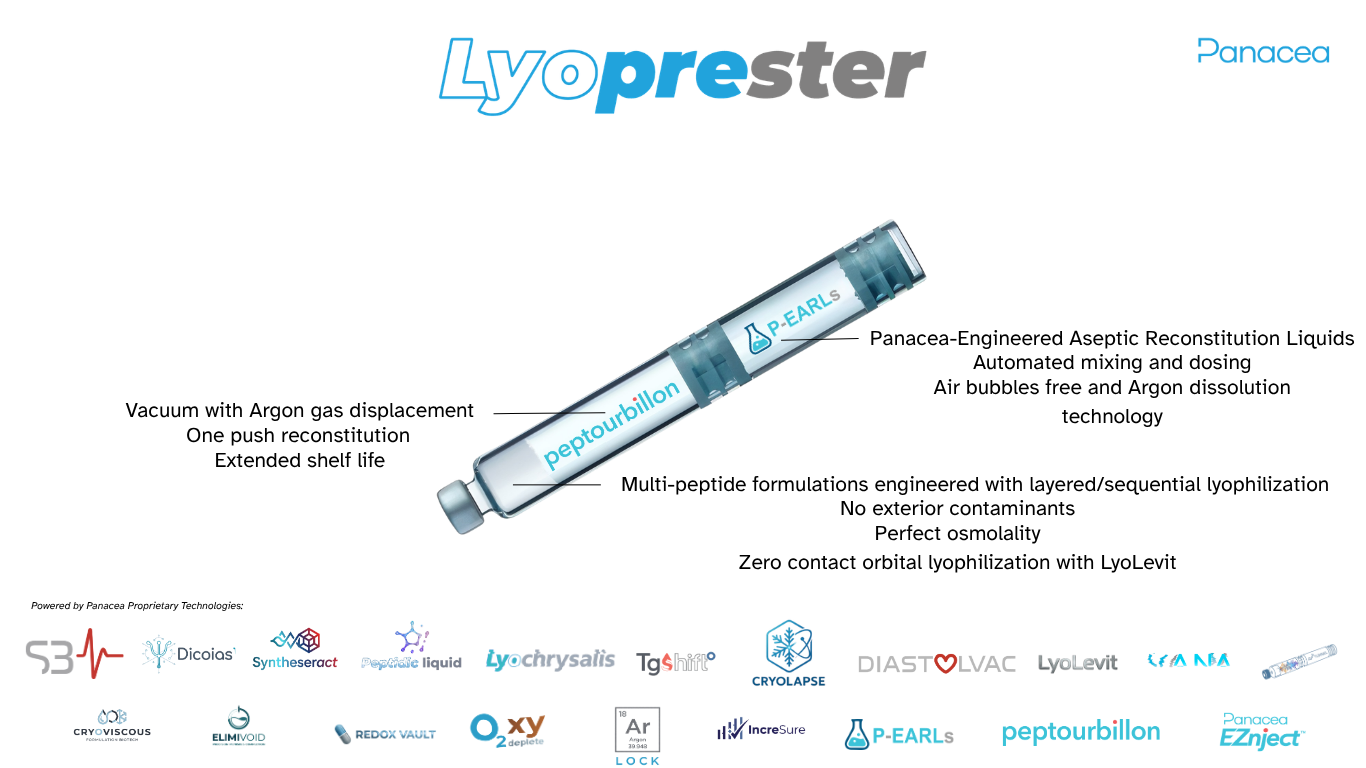
- Lyoprester® ↗The dual-chamber peptide instrumentThe intelligent-reconstitution instrument: a low-temperature-dried peptide cake in one chamber and its diluent in another, kept apart until they are reconstituted at the point of use.
- Lyochrysalis™ ↗The lyophiliserThe freeze-dryer at the heart of the process — removing water from fragile peptides under the low-temperature discipline that protects their structure.
- LyoLevit™ ↗Contact-free radiant dryingDries the cake by 360-degree radiation with zero wall contact instead of shear against a hot shelf — the gentlest way to remove water from something that hates being dried.
- PleniDose™ ↗The dosing gantryThe gantry that sets the cartridge plungers and aliquots the treated liquids, entrapping the fill bubble-free within a near-airless environment before the cap is crimped on.
- Peptourbillon™ ↗The formulation engineComposes the multi-layer peptide recipe — the layered cake structure the Lyoprester builds and the doses it carries.
- VANAThe vacuum machineDraws the cartridges down to vacuum and, when used, backfills only a fraction of that vacuum with argon at reduced pressure.
- EZnject™ ↗Point-of-use deliveryReconstitutes the dual-chamber cartridge and injects it in one motion at the point of use.
- S3Pulse ↗The biointegrity engineThe software that models formulation, preservation and process integrity across a run — the digital backbone of the system.
- SYNTHESERACT™ ↗Adaptive peptide synthesisThe adaptive continuous-flow platform that builds the amino-acid chains the rest of the system preserves and delivers.
- CFSPPS ↗Continuous-flow SPPSContinuous-flow solid-phase peptide synthesis — the chemistry SYNTHESERACT runs to assemble each sequence.
Frequently asked
What are the Panacea Technologies?
The technologies invented by Bogdan Dicoias at Panacea Bio Chem to synthesise, dry, preserve, dose and deliver fragile peptides intact — from the Lyoprester and Lyochrysalis instruments to TgShift, Cryolapse, OxyDeplete, ArgonLock, RedoxVault and the S3Pulse biointegrity engine.
Who invented them?
Bogdan Dicoias — biochemist, amino-acid-chain designer and founder of Panacea Bio Chem. Each is proprietary to Panacea Bio Chem Ltd.
How do they work together?
As one interconnected process — synthesise, formulate, dry under a low-temperature discipline (finishing at −3 to −5 °C, sublimation ending at −8 to −10 °C, desorption at −3 to −5 °C, no +40 to +60 °C overheat), seal oxygen-depleted under argon, and deliver from a dual-chamber cartridge — all aimed at preserving binding affinity and bioavailability.
Is anything here medical advice?
No. This page describes technologies for scientific context. Nothing here is medical advice.
Trending across the network
Recent developments in the field — refreshed 2026-10-19 by Panacea Bio Chem.
- Peptide-Mediated Precise Intracellular Delivery of Bioactive Substances — PubMed, 2026
- Emerging NPR-B agonists for cartilage and bone: from CNP biology to translational compound design — PubMed, 2026
- A Hierarchical Dual-barrier Nanoparticle System Combining Solid Lipid Nanoparticles and Enteric Coating for Effective Oral Insulin Delivery — PubMed, 2026 Oct 12
- Interpretable machine learning framework for peptide lead optimization in ultralarge design spaces — PubMed, 2026 Oct 12